
Higher Rates, Tighter Math: What CRE Investors Should Watch Next

Each quarter, Head of Commercial Finance Jeff Lanier and Senior Vice President/Regional Manager of National Capital Markets Warren Samek discuss the factors influencing CRE and capital markets.
In the latest update, they discuss higher rates, changing regulations and how CRE is staying nimble to secure capital as AI development is increasingly competing for funding.
Browse a practical read on refinancing risk, lender shifts, concentrated distress, AI-driven capital competition and Opportunity Zones 2.0.
Follow along with the Q4 presentation
Higher Rates Are Rewriting the CRE Playbook - Here’s Where Deals May Still Work
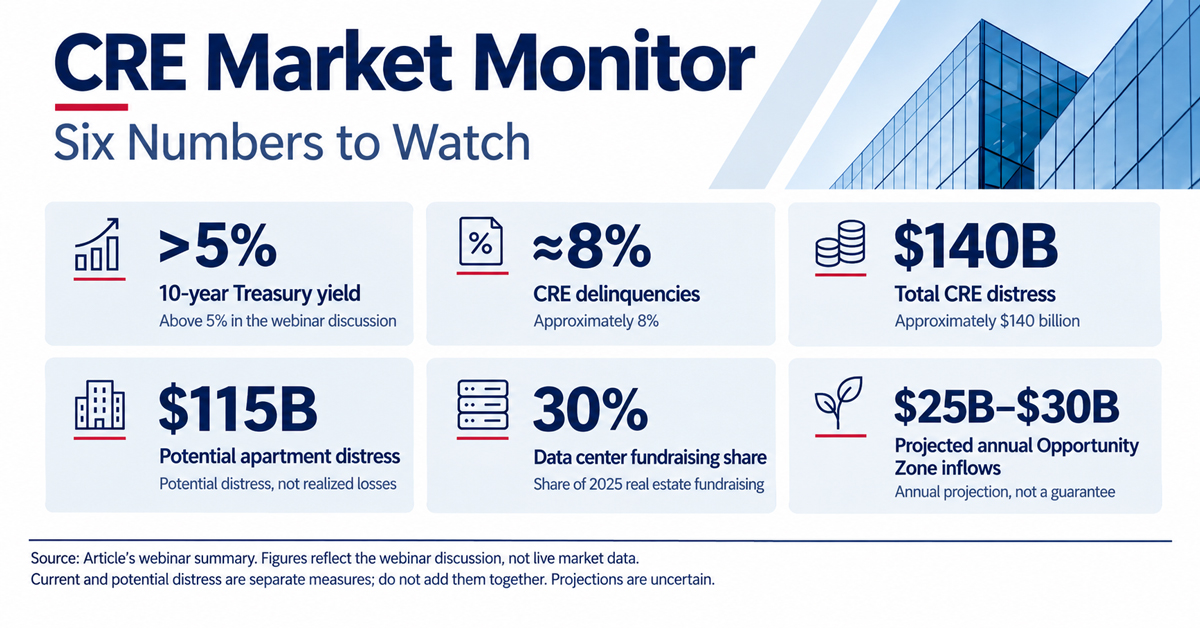
The economy still has momentum. Commercial real estate financing does not have the same luxury. With the 10-year Treasury above 5%, delinquencies near 8% and a large volume of debt still waiting to refinance, investors and developers face a market where capital exists, but easy math does not.
The practical takeaway:
- Underwrite for a longer period of elevated rates
- Expect more lender variety
- Expect more lender variety
- Look for opportunities where patient equity can solve a capital-structure problem
Office and multifamily require the sharpest risk lens. Private credit, rescue capital and the next generation of Opportunity Zones may offer more room to maneuver.
Watch the entire CRE market breakdown in the Q4 Commercial Market Monitors Webinar
Q4 Commercial Market Monitors Recording
Key Highlights
- Rates may stay higher: The 10-year Treasury could settle near 4.75%.
- Refinancing risk is shifting: Loan extensions are delaying the CRE maturity wall.
- Private credit is expanding: Alternative lenders may help close financing gaps.
- Distress remains concentrated: Office and multifamily face the greatest exposure.
- AI is competing for capital: Increased demand may keep CRE borrowing costs elevated.
- Opportunity Zones are evolving: The permanent program begins January 1, 2027.
- Execution is critical: Conservative underwriting and flexible capital may help deals pencil.
In This Article
What Matters Most for CRE Investors and Developers?
Why Could the 10-Year Treasury Stay Elevated?
Is CRE’s Refinancing Wall Actually Getting Smaller?
Who Is Lending When Banks and Borrowers Cannot Close the Gap?
Where Is Commercial Real Estate Distress Concentrated?
How Is AI Investment Affecting CRE Capital Costs?
What Changes with Opportunity Zones 2.0?
What Matters Most for CRE Investors and Developers?
Price the exit before you price the entry. A 10-year Treasury near the mid-to-upper 4% range would still keep borrowing costs elevated. Deals that depend on a quick return to 3% Treasury yields may need a tougher base case.
Treat extensions as a delay, not a cure. The maturity wall is not shrinking as quickly as headlines may imply. Loan modifications and extensions are rolling maturities forward, which may create future recapitalization needs.
Broaden the lender set early. Investor-driven lenders, including debt funds and private credit, have roughly doubled their share since 2017. They may be essential sources of bridge and rescue capital as the 2027 refinancing gap approaches.
Separate property-level risk from sector headlines. Distress is heavily concentrated in office and multifamily. That calls for sharper asset-level diligence, not a blanket assumption that all commercial property is impaired.
Watch where the marginal dollar goes. Government borrowing and AI-related infrastructure investment are competing for capital. That may keep spreads wider and coupons higher even if the broader economy remains decent.
Why Could the 10-year Treasury Stay Elevated?
The webinar’s best-interpretation read is that the 10-year Treasury may settle near 4.75%, rather than fall back into the 3% range. Three forces support that view: oil and geopolitical shocks, record AI-related debt issuance competing for buyers and rising Treasury supply tied to the national debt.
If the oil shock eases, the 10-year could move into the mid-to-upper 4% range. That would help at the margin, but it would not restore the financing environment behind many older business plans.
Jeff Lanier
Head of Commercial Finance, Q4 Commercial Market Monitor webinar
My personal view is we’re on the right side, higher for longer, probably in that 4.75% range.
Is CRE’s Refinancing Wall Actually Getting Smaller?
Not necessarily. Delinquencies are about 8%, their highest level in years, while extensions and modifications continue to push maturities into later periods. That suggests refinancing pressure may be moving across the calendar rather than disappearing.
For sponsors, this may increase the value of early lender conversations, updated valuations and multiple recapitalization paths. For investors, it may create opportunities to provide preferred equity, rescue capital or structured debt where senior proceeds no longer cover the existing basis.
Who is Lending When Banks and Borrowers Cannot Close the Gap?
The lender mix is changing. Banks are back at about 43% of the capital stack, while investor-driven lenders such as debt funds and private credit providers have roughly doubled their share since 2017. The summary suggests these nonbank lenders could help fill the 2027 refinancing gap with bridge and rescue capital.
That flexibility comes with a trade-off. Private capital can move faster and structure around complexity, but borrowers should expect pricing and controls that reflect the risk. The useful question is not simply, “Is capital available?” It is, “What does this capital require the asset to do, and by when?”
Warren Samek
Senior Vice President and Head of Capital Markets, Q4 Commercial Market Monitor webinar
They’re going to be the heroes with the bridge loans, rescue capital, high-leverage refis.
Where is Commercial Real Estate Distress Concentrated?
Total CRE distress is about $140 billion, with nearly half tied to office. Apartments carry another $115 billion of potential distress. Most troubled situations are expected to resolve through recapitalizations and loan modifications rather than foreclosure.
For office investors, leasing assumptions, tenant rollover and capital expenditures deserve more scrutiny than a broad “return to office” thesis. For multifamily investors and developers, potential distress may point to refinancing and basis-reset opportunities, but only where operating fundamentals and new debt costs support the plan.
How is AI Investment Affecting CRE Capital Costs?
AI is becoming a major competitor for capital. The webinar projected AI-related investment at about 3.63% of U.S. GDP annually and described it as the largest infrastructure bet in U.S. history. Data centers captured 30% of real estate fundraising in 2025.
For CRE, that concentration may mean wider spreads and higher coupons as investors allocate more capital to AI infrastructure and the debt supporting it. Developers should factor capital competition into timing, financing contingencies and required returns, especially for projects that do not offer data-center-like growth narratives.
Warren Samek
Senior Vice President and Head of Capital Markets, Q4 Commercial Market Monitor webinar
The result is going to be some wider spreads and higher coupons for everybody else waiting in line.
What Changes with Opportunity Zones 2.0?
Opportunity Zones 2.0 begins January 1, 2027, and is permanent. The program is expected to include about 25% fewer zones, a rolling five-year deferral and a stronger rural emphasis. Projected inflows are $25 billion to $30 billion annually.
The opportunity comes with more reporting and a transition period. Two maps will overlap through 2028. Investors and developers evaluating Opportunity Zone strategies may need to confirm which designation applies, model the timing of capital gains and prepare for heavier documentation before committing to a site or fund structure.
Warren Samek
Senior Vice President and Head of Capital Markets, Q4 Commercial Market Monitor webinar
Opportunity Zone equity is patient, tax-motivated capital, and patient equity is exactly what’s scarce right now.
What Could CRE Teams Do Now?
- Re-underwrite floating-rate and near-term maturity exposure using a higher-for-longer base case.
- Start refinance and recapitalization discussions before a loan enters its final 12 months.
- Map bank, debt fund, private credit and preferred-equity options instead of relying on one lender channel.
- Segment office and multifamily exposure by asset quality, basis, leasing risk and capital needs.
- Test whether AI and data-center capital flows are changing local land, power, construction or financing economics.
- Begin Opportunity Zones 2.0 diligence early, especially for rural projects and deals that may span the 2027 transition.
The market is not closed. It is selective. Deals with realistic rate assumptions, flexible capital and enough time to solve the stack may have an edge over sponsors waiting for the old financing environment to come back
Disclaimer: This article is based on commentary and market data presented during Stewart’s Q4 Commercial Market Monitor webinar. The information is provided for general educational purposes and reflects market conditions, projections and opinions discussed during the presentation. Forecasts and forward-looking statements are inherently uncertain, and actual market conditions may differ.
This content does not constitute legal, tax, investment or financial advice. Commercial real estate investors, developers and other professionals should consult their legal, tax and financial advisors and conduct independent due diligence before making investment, financing or development decisions. References to Opportunity Zones and potential tax benefits are subject to applicable laws, regulations and program requirements
faq
Frequently Asked Questions
The webinar suggests the 10-year Treasury may remain elevated near 4.75%. An easing oil shock could move it into the mid-to-upper 4% range, but the summary does not point to a return to the 3% range.
Higher borrowing costs, delinquencies near 8% and a maturity wall extended by loan modifications are keeping refinancing pressure in the system.
Office accounts for nearly half of roughly $140 billion in total distress. Multifamily carries about $115 billion of potential distress.
Debt funds and private credit providers may supply bridge and rescue financing, particularly around the expected 2027 refinancing gap.
Opportunity Zones 2.0 begins January 1, 2027. It is permanent and is expected to feature fewer zones, a rolling five-year deferral, a rural tilt and heavier reporting.